
Why “National” and “Western” Painting Categories Endured in Japan but Dissolved in China?
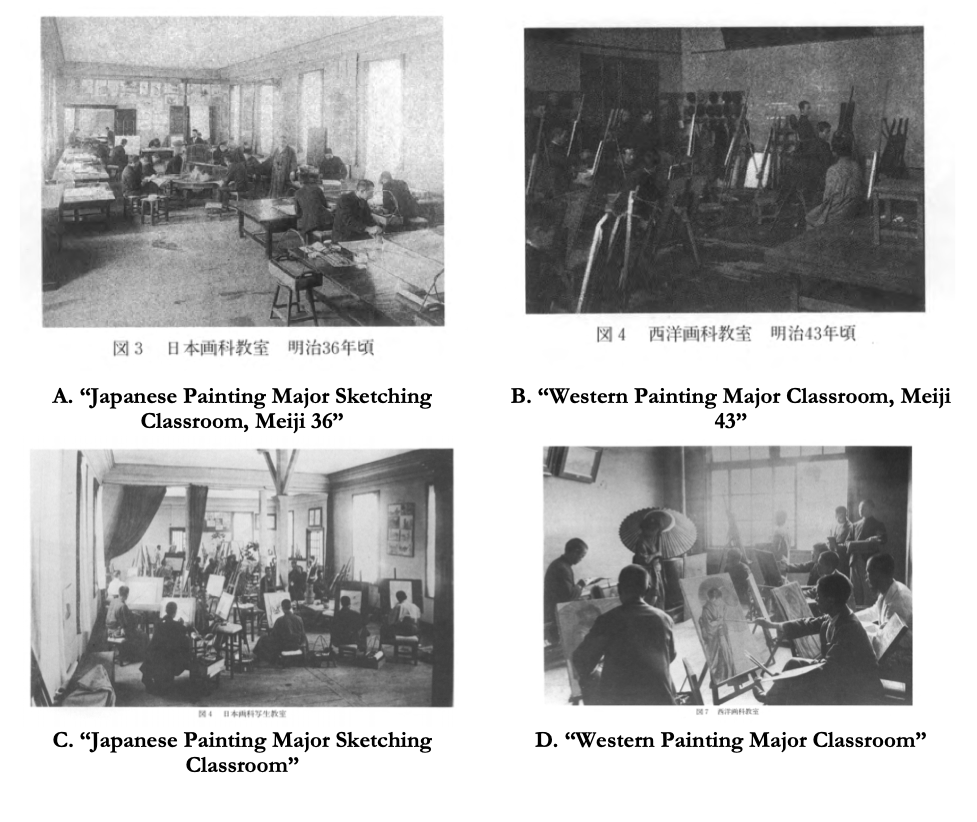
Photos of classroom settings in Tokyo School of Fine Arts
Wang, Yangyu, ongoing, single-authored paper.
Abstract: This paper asks why boundary-making between “national” and “Western” painting became an enduring classificatory infrastructure in Japan from the late nineteenth century onward, while a similar binary emerged in Republican China but later weakened and gave way to medium-based distinctions such as ink painting and oil painting. Rather than treating these labels as neutral descriptors, I analyze them as institutionalized cultural categories that organized exhibition systems, educational curricula, critical discourse, and market legibility. The project compares Japan from the 1860s to the 1910s with China from the 1910s to the 1940s and develops three explanations for divergence: differences in cultural classificatory repertoires, differences in state and quasi-state institutional embedding, and differences in market-making and intermediary coordination. Empirically, the paper draws on design materials and two pilot analyses. The first traces shifts in classification vocabulary across exhibition catalogues, collection records, and public reporting, showing that Chinese painting categories moved from mixed dynastic and medium labels toward unstable “Chinese/Western” oppositions and then toward more differentiated historical and contemporary labels, whereas Japanese classifications stabilized early around the binary of nihonga and yōga. The second examines educational institutionalization, showing that Tokyo School of Fine Arts gradually formalized separate tracks for Japanese and Western painting even when classroom practice and visual output remained more continuous than the categories suggested, while Chinese educational institutions appear to have moved toward weakening the binary. Together, these findings suggest that durable artistic categories depend less on intrinsic aesthetic difference than on whether institutions repeatedly reproduce, codify, and naturalize them.